
UX Research for Ontario Energy Board's Redesign
Research Process
Survey Planning
Survey Results
User Interview Planning
User Interview Results
Usability Testing Planning
Usability Testing Results
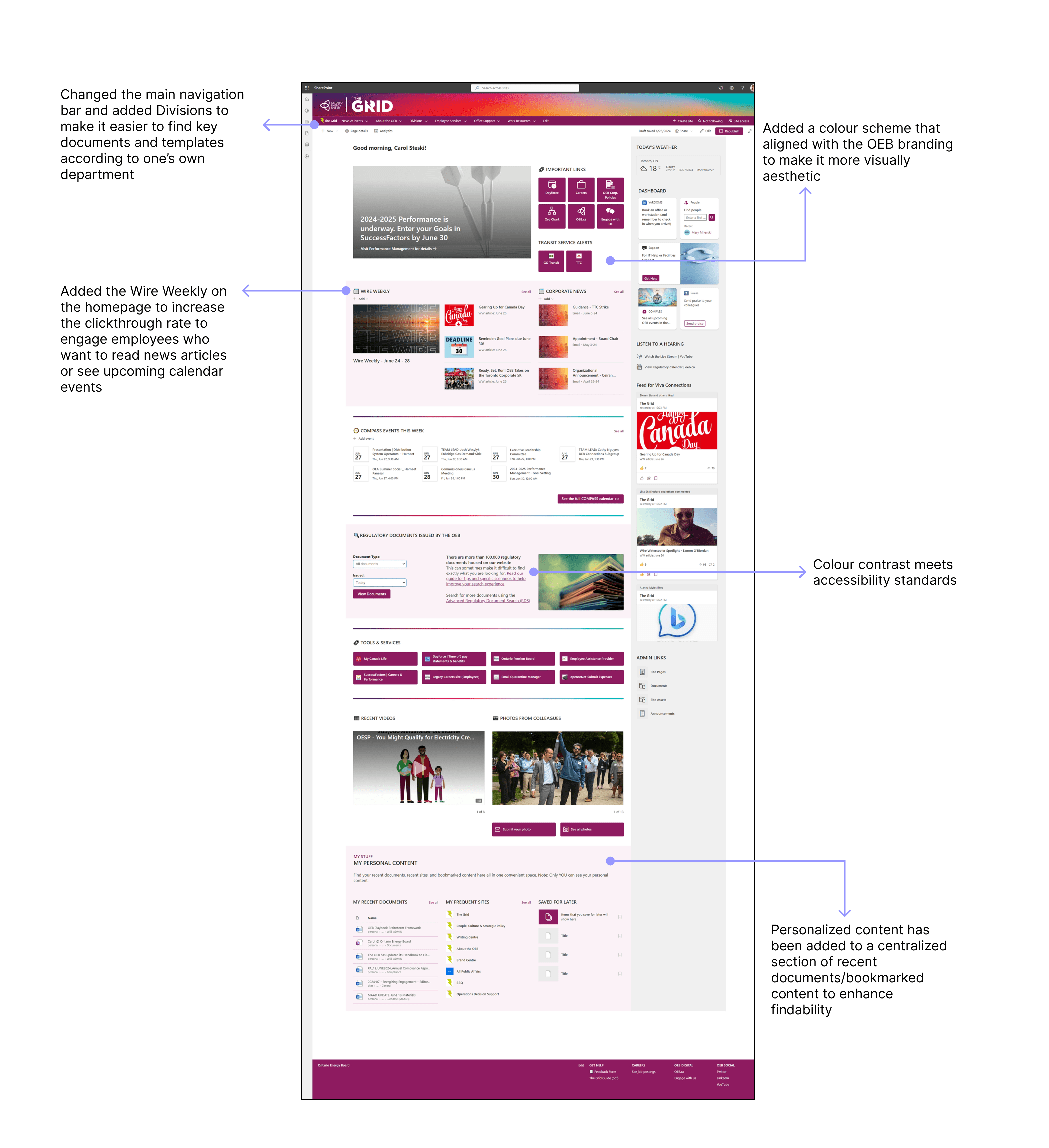
Final Look of the New Intranet
2025 Survey Results
2023 vs. 2025 Survey Findings
Future Steps
About the project
I evaluated current state intranet to inform the redesign, which led to increasing engaging content by 30%, increasing overall usefulness/relevance to work by 18%, and enhancing user experience by 10%.
Timeline:
May - Sep 2023 (ux research activities), Feb 2025 (updated survey results)
Tools:
Excel, SurveyMonkey, Google Analytics
Role:
Primary Research Lead
Team:
Helen Chan (me), Carol Steski, Robert Stephen, Ashraf Ali, Lara Pocock
Methodology
Survey, user interviews, moderated usability testing in-person
Current State Intranet
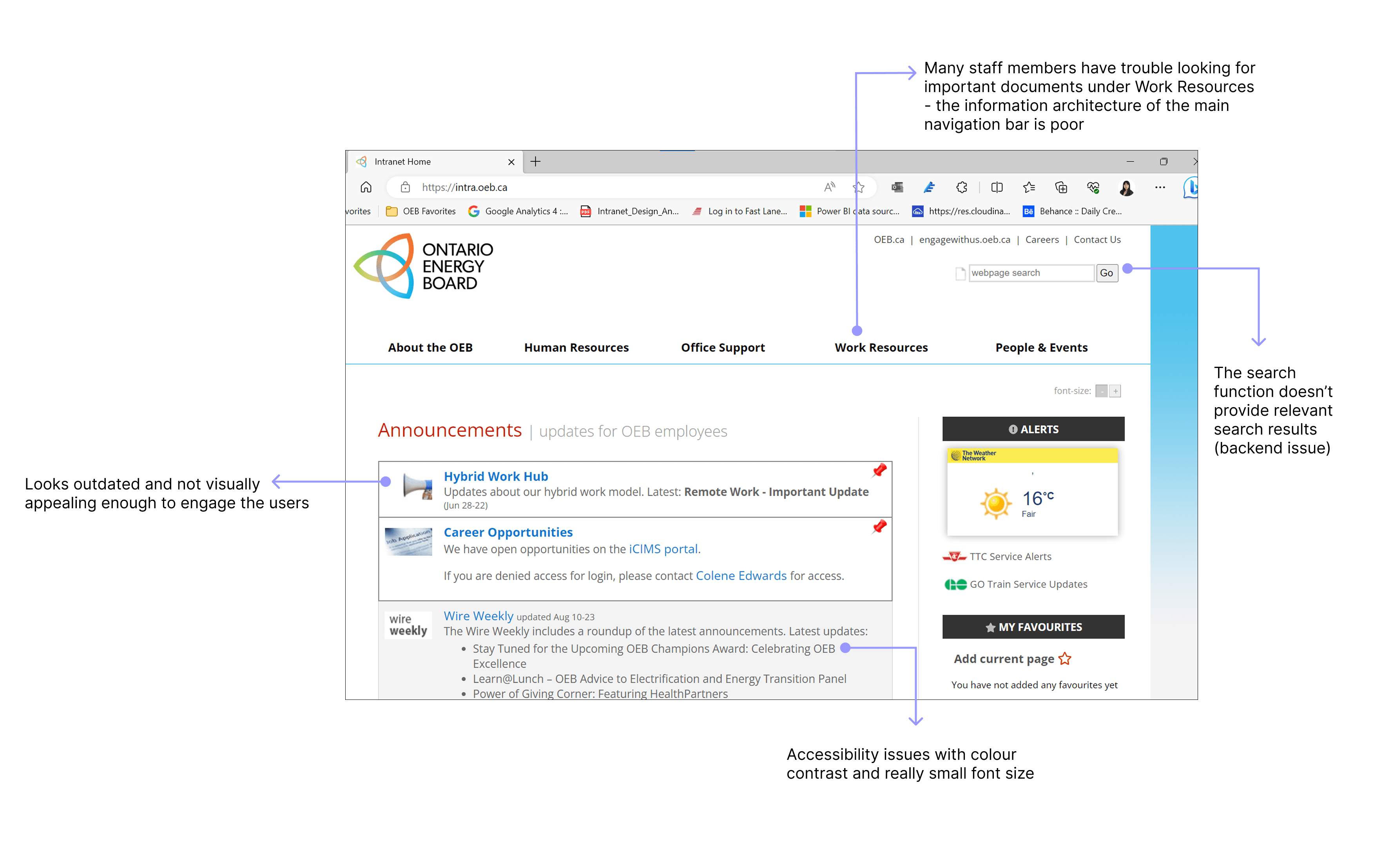
OEB’s intranet serves as a central hub of information for employees, which includes a repository of policy initiatives and consultations, forms and templates, company goals and strategies, and ongoing events.
The goals of the redesign project are the following:
Create a modern, clean design that aligns with OEB’s evolved brand.
Promote efficiency and enable productivity by centralizing the digital workplace with access to tools and content employees need and want.
Enhance knowledge and connect employees to business, timely content, and use of data to bring corporate activities to the forefront (e.g., status of scorecards, performance cycle countdowns).
Survey 2023
Survey Planning
I surveyed 96 OEB staff members to understand their experiences with the current intranet.
The following survey questions were asked:
On average, how often do you visit the OEB intranet?
Please rate the following about your use of the intranet:
Overall, I find the current intranet useful to my work.
I have a good understanding of what information and resources are available.
I can easily find the information I’m looking for.
The main navigation menu helps me find the information I need.
The search function helps me find the information I need.
Content on the intranet is relevant to my work.
Content is engaging and helps connect me to the OEB’s strategic priorities.
The intranet’s design is aesthetically appealing and reflects the OEB’s culture.
Rank the qualities (1 = most important, 10 = least important) that are most important to you on an intranet.
Simple navigation
Looks good
Solves a particular problem
Information about co-workers is easy to find
Ability to personalize/customize my view/content
Information about events
Centralized access to OEB documents
Relevant search results
Integration with other IT applications (e.g., MS Office, Teams, etc.)
Information about corporate milestones and news
What things are working well on the intranet (open-ended)?
What could be improved? Is there any content you think is missing (open-ended)?
Have you used an intranet in another job? If so, what features did you find useful (open-ended)?
Do you have any additional comments or ideas about the intranet (open-ended)?
Survey Results
Key Findings:
Respondents prioritize simple navigation, centralized access to OEB documents, and relevant search results.
While many find current pages easy to access, improvements are needed in search functionality, overall UI, integration with other systems, and the reintroduction of the staff directory.
Customizability is suggested by some participants.
Common issues reported include poor search functionality and poor findability of items such as OEB policies and important documents or resources.
43% ranked valuing having simple navigation, followed by 18% wanting centralized access to OEB documents, and 17% receiving relevant search results.
Regarding useful features from intranets from previous workplaces, participants liked the ease of navigation, up-to-date content, useful tools (e.g., employee directory), and personalized content.
User Interviews
User Interview Planning
To gather an in-depth understanding of the participants' pain points, desires, and needs with using the intranet, I conducted user interviews with 7 staff members. The plan included writing a proposal and aligning with internal stakeholders on the research objectives prior to moderating the interviews in-person.
User Interview Results
Here are the actionable improvements based on what was said in the interviews:
Address back-end issues to enhance the search function (3/7 participants found it problematic).
Improve site accessibility by adjusting small text and reducing text-heavy content.
Enhance user-friendly layout, particularly on the homepage, for a more engaging experience.
Add more color, especially to Announcement pages, to improve the overall look and feel.
Optimize navigation for Wire Weekly (OEB’s newsletter).
Modernize the intranet to align with OEB’s evolving goals and values, adding depth and breadth.
Organize the menu for better intuitiveness, aligning page names with menus.
Reinstate the Employee Directory for easy staff member identification.
Consider creating a dedicated events page for easier access than searching through Wire Weekly or Teams notices (nice to have).
Usability Testing
Usability Testing Planning
Finally, I led 9 moderated usability testing sessions for 6 tasks to test the usability of the current intranet. The plan involved an internal stakeholder meeting to align on the objective of usability testing and walking them through on how I would execute the process prior to this research phase. In some sessions, I had the digital advisor shadow me to get the full picture of what usability testing entailed.
During the test, participants were given six tasks:
Find the March 23, 2022 article on preparing for our hybrid return to office.
Find Employee X's job title.
Find the burgundy PowerPoint template.
Find the corporate scorecard 2022 - 2023 Quarter 2 for Public Affairs.
Find the OEB’s vision statement.
Find out when yoga is happening.
Usability Testing Results
6/9 failed the first task. This was the most difficult task to complete as participants took the longest time on task.
2/6 participants gave up after looking in the correct section (the Wire) but not being able to find the article.
3/9 participants failed the 4th task.
For those that failed, ⅔ participants tried to use the search function to look for the corporate scorecard.
When asked whether anything frustrated them the most about the intranet, here is what participants said:
Final Look of the New Intranet
Survey 2025
Analysis of Survey 2025 Results
Context:
The user survey was conducted with 48 participants in February 2025 to analyze the improvements and user experience of the redesigned Intranet. This survey marked the wrap-up of the intranet research project. Since I wasn't part of this phase, I reached out to the digital advisor to capture these research findings and analysis.
2023 vs. 2025 Survey Findings
From 2023 to 2025, there’s a steady rise in positive user experience and a low rate of dissatisfaction. The intranet’s content has improved in content relevance and has become more meaningful to employees and their work. Employees are able to find more services and are able to navigate the website with little issues.
There is an increase in the intranet’s usefulness, content and user experience.
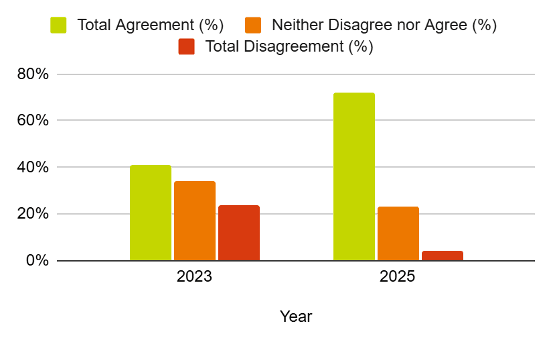
Figure 1.0. A comparison of the 2023 vs. 2025 total agreement, indifference and total disagreement for content relevance.
Survey Statement #1: Content on the intranet is engaging and helps connect me to the OEB’s strategic priorities.
Engaging content increased by +30%.
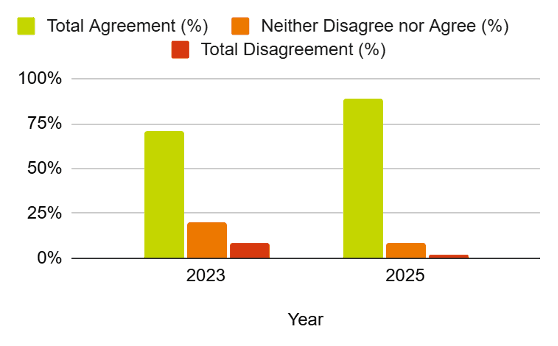
Figure 2.0. A comparison of the 2023 vs. 2025 total agreement, indifference and total disagreement for usefulness.
Survey Statement #2: Overall, I find the intranet useful to my work.
Overall usefulness/relevance to work increased by +18%.
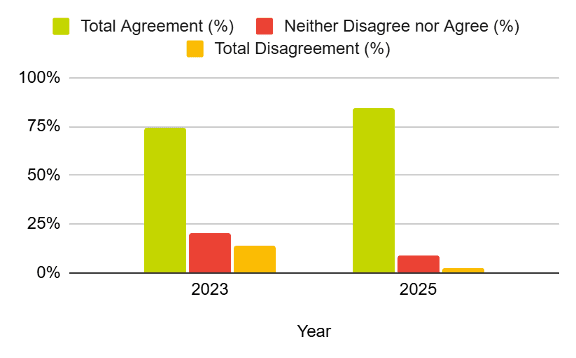
Figure 3.0. A comparison of the 2023 vs. 2025 total agreement, indifference and total disagreement for user experience.
Survey Statement #3: I have a good understanding of what information and resources are available on the intranet.
User experience increased by +10%.
The Intranet Usage Comparison 2023 vs. 2025
Survey Question: On average, how often do you visit the OEB intranet?

There is an overall increase in engagement:
At least once per day – increased by 3.8% users are accessing the intranet more frequently.
3-4 times per week – increased by 6.7%.
Lower frequency users (once per week, once or less per month) are converting. Fewer users are using the intranet infrequently as it dropped by -10.5%, suggesting that the intranet is becoming more useful and essential.
Future Steps
Resolve search function so that results are not file embedded in folders (lead to exact page) and search uses “exact words” instead of “similar words”.
Improve the Wire navigation system so that users can switch between articles. The following items are suggested:
Make it accessible in one scroll page.
Create Next buttons feature to switch articles.
Get rid of the “byline” template text.
Create easy access to adjunctive templates, templates for onboarding, regulated documents and recent OEB Publications.
Add and improve the OEB Directory to see projects staff are working on, who reports to who and are responsible for.
Consider conducting user surveys with the same number of participants to compare results accurately (i.e., preferably recruit a higher number of participants).
Lessons Learned
Be proactive about asking for feedback
Sometimes I felt too hyperindependent working on my own research tasks without asking anyone for constructive feedback. Reflecting back on the project, it would have been advantageous to create a research roadmap and share the importance and value of each research item with my team.
Conduct a thorough heuristic evaluation
Although I spoke with my team members about the UX issues I noticed on the website, it would have been an ideal approach to follow Nielson's Top 10 Heuristics and provide a more standardized way of listing the usability issues and its severity. Doing a heuristic evaluation before conducting UX research studies would have helped gain stakeholder buy-in when key usability issues are shown clearly upfront.